Competitive intelligence for mid-market GTM teams.
Visualping tells you a page changed. Klue and Crayon charge $15K–$40K/yr to tell you what it means. PriceForge does both — for the price of a Notion seat.
Built for mid-market GTM teams that need real CI without a dedicated analyst or enterprise procurement. Watch competitor pricing, packaging, messaging, reviews, hiring, ads, and release velocity from one workspace—with AI summaries, battlecards, and intelligence history.
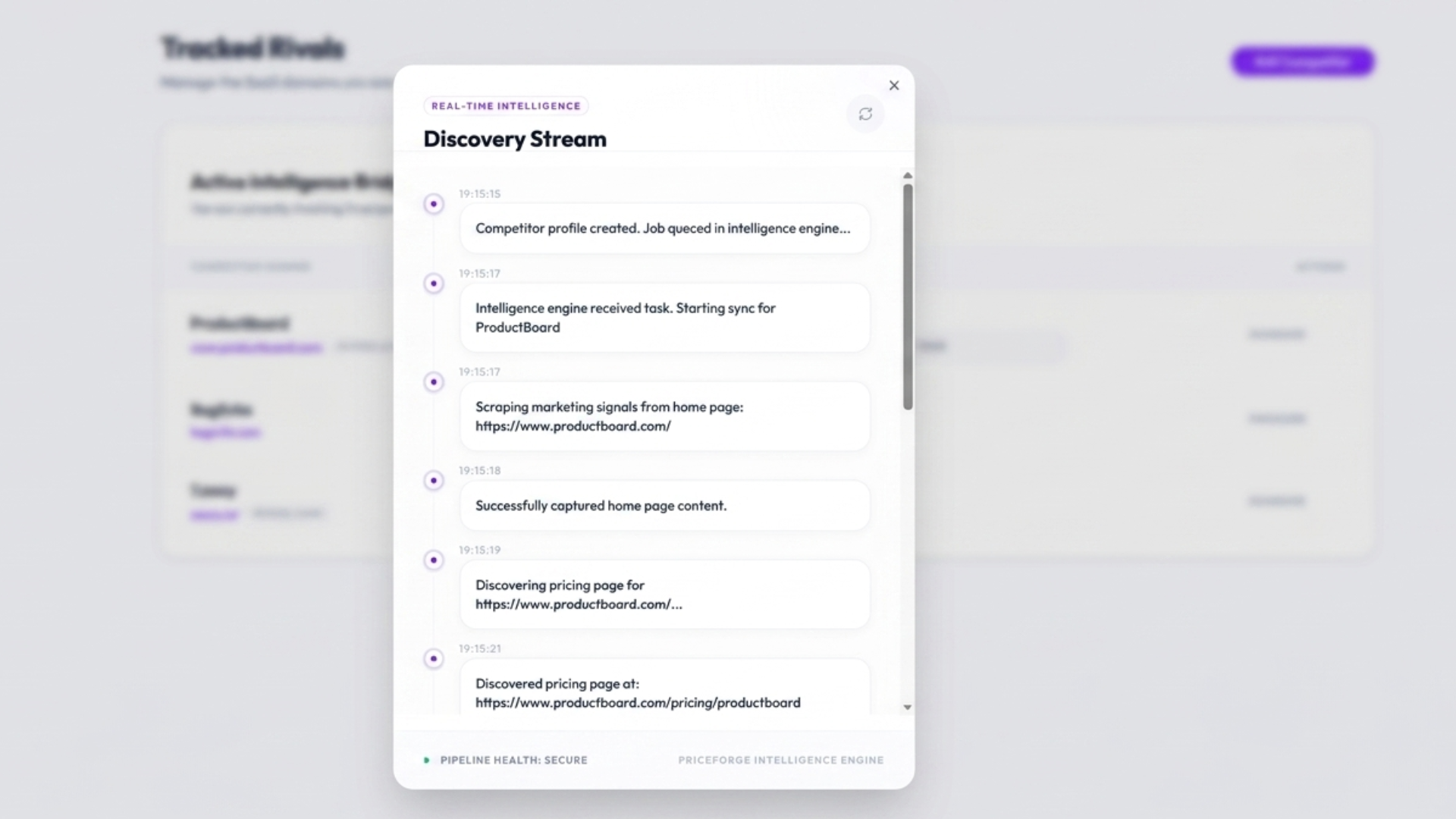
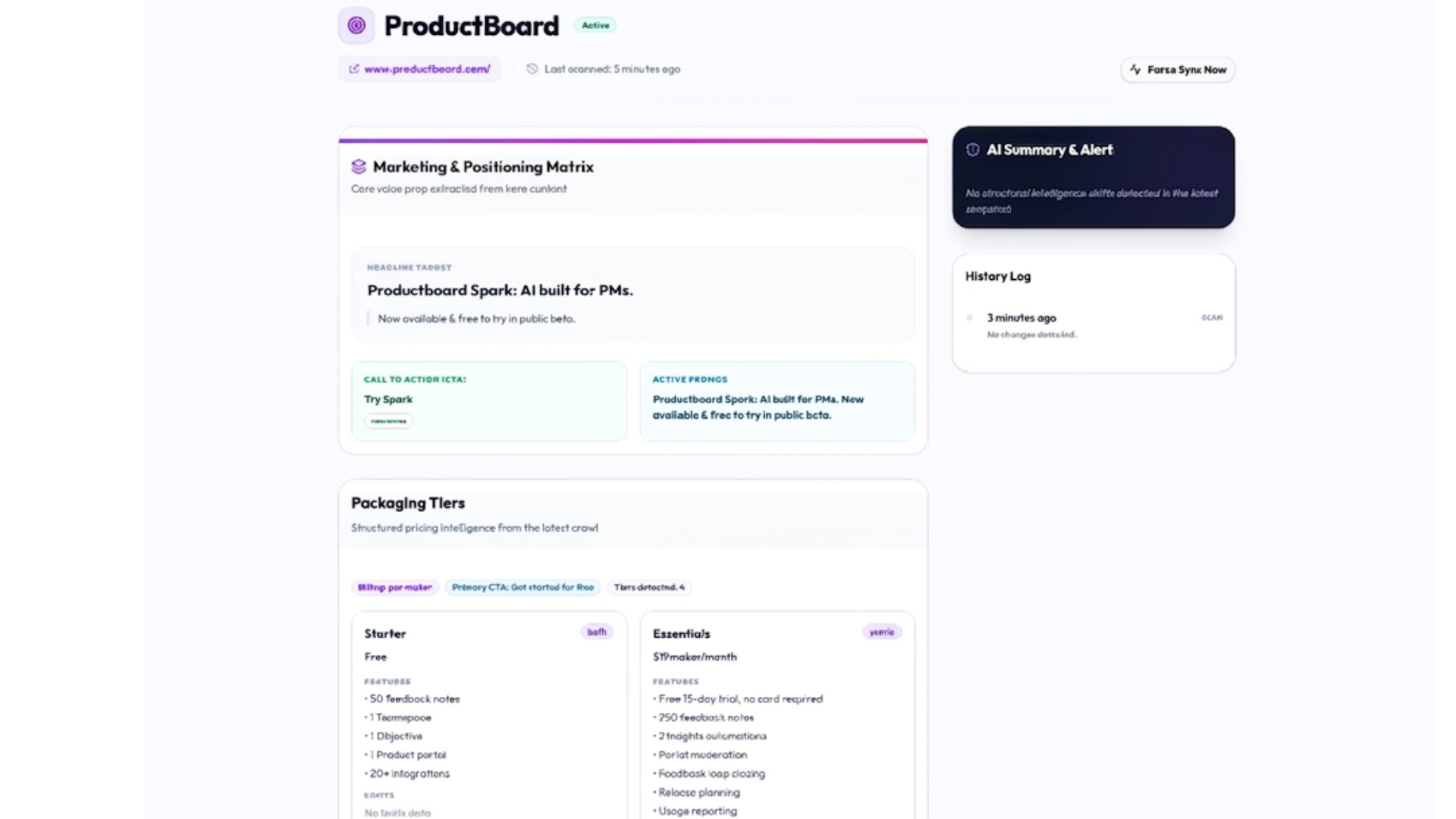
Add a competitor and get a live snapshot plus what they changed this month—before your first scheduled refresh.
First competitor sync includes month-to-date intelligence (30 credits). Ongoing refreshes stay at 25 credits each.
Who mid-market teams put on PriceForge
PMM at Series A–C SaaS
RevOps & pricing leads
Sales enablement
Founder-led GTM
priceforge.org/dashboard
ACTIVE BRIDGES
14
MARKETING SHIFTS
6
PACKAGING SHIFTS
3
SENTIMENT ALERTS
12
Packaging compare
Side-by-side tiers pulled from tracked pricing pages—same view your team sees in the workspace.
Demo
Comparetracked
Northbeam
Growth
$299
vs
Vertexly
Scale
$349
Net +$50/mo
Comparetracked
CloudSync
Business
$89
vs
StackForge
Team
$79
Net −$10/mo
Comparetracked
DataPulse
Pro
$45/seat
vs
MetricHub
Pro
$52/seat
Net +$7/seat
Active Intelligence Channels
Te
TechCorp
CHANGE DETECTED
Cl
CloudSync
OPTIMIZED
Recent Field Intelligence
Claim
"They just launched a new tier for Enterprise."
Approved
Field proof
“We walked into a $450k renewal with the competitor's new limits in our battlecard the same day they shipped, which gave our reps a decisive objection-handling advantage.”
VP Revenue, Series B SaaS (40-person GTM team)
Cost reality
Typical CI platform: $15K-$40K/year. PriceForge Intelligence: $149/month.
Typical CI platform$15K-$40K/yr
PriceForge Intelligence$149/mo
Built for mid-market B2B SaaS—not ecommerce or enterprise CI programs
CI platform power without CI platform overhead or headcount
Catch packaging, positioning, and pricing shifts early
Layer in review, hiring, and ad signals when the pricing page is not the whole story
Push the brief into Slack, Notion, or your battlecards in minutes
Built for mid-market teams that need clear competitive evidence in active deals
Marquee benefit
AI summaries with a ready counter-move, not just a change alert
Example alert: "Competitor X added a cheaper Scale plan with 2x users at 20% lower price; risk: mid-market expansion deals may see higher discount pressure."
Suggested moves: "Add objection handling note; tighten price floor in deals vs X; consider matching usage limits on Scale tier."
How it works
A simple workflow your team can run every week
Replace ad-hoc page checks with one repeatable process for mid-market PMM, pricing, and enablement teams—no dedicated CI hire required.
https://competitor.com/pricing
https://rival.io/pricing
Step 1
Add a competitor and get instant context.
Your first sync captures a live snapshot plus what changed this month on pricing, packaging, and messaging—then keeps watching on your plan cadence.
Competitors do not telegraph their next move on the pricing page alone. PriceForge watches the surfaces where mid-market rivals actually show strategy—and tells you what each shift means for your deals.
Core
Pricing & packaging
Tier launches, price changes, feature gates, plan renames, usage limits, and credit math—structured by the AI, not just screenshotted.
Core
Messaging & positioning
Hero copy, value props, audience pivots, and bundle renames captured the week they go live—so decks and talk tracks stay accurate.
Core
Release & changelog velocity
Changelogs, GitHub releases, Headway, and Canny ingested into one feed so you can see shipping cadence and theme shifts over time.
360° module
Review intelligence
Sentiment from G2, Capterra, and other review surfaces—objections, churn drivers, and loved features your reps can quote today.
360° module
Hiring signals
Open roles, keywords, and team expansion patterns. See where competitors are investing months before the public launch.
360° module
Ad intelligence
Themes, keywords, and spend tier across Meta, LinkedIn, and Google. Spot positioning experiments and budget shifts early.
Weekly strategic synthesis
One cross-signal narrative, not six dashboards to stitch together.
Every week PriceForge synthesizes the price moves, review pain, hiring direction, and ad pressure for each competitor into a short narrative—the brief your PMM lead would write if they had time.
Slack alerts
Notion battlecard sync
Weekly email digest
CSV & PDF exports
Positioning simulator
Alert rules & recipes
Every paid plan includes one 360° module free. Add more for $19/mo each—each extra module also adds 1,500 credits/mo so the core sync budget stays intact.
Why teams choose PriceForge
Built for mid-market GTM teams, not generic page monitors
You have real competitive pressure and real deals on the line—but not a full-time CI lead or a six-figure tool budget.
Business context instead of raw diffs
See what changed and why it matters across packaging, positioning, reviews, hiring, and ads. Stop digging through noisy HTML diffs to find the moves that actually affect deals.
Evidence your team can verify
Each important update links to timestamped screenshots for clear internal alignment. Every alert links to a before/after view captured at the time of the change.
Workflows for PMM, pricing, and enablement
Ship updates in formats useful for battlecards and field messaging, not engineering logs. Sync to Notion battlecards, fire Slack alerts, or export to Google Docs—whatever your team already runs.
Product capabilities
Evidence capture, intelligence history, battlecards, and weekly strategic synthesis—built for day-to-day execution by PMM, pricing, and enablement.
Competitive intelligence that maps to how you work
These topics match the problems behind our product: monitor rivals, explain what changed in business language, and ship updates to pricing, PMM, and sales without a manual crawl.
Competitor pricing & plan monitoring
Teams need to know when rivals change tiers, usage limits, credits, or list prices—before renewals and competitive deals go sideways.
competitor pricing tracking
SaaS pricing page monitoring
plan tier change alerts
competitive pricing intelligence
Packaging, features & positioning
Product marketing needs to catch feature gating, bundle, and messaging shifts on competitor sites so GTM and decks stay accurate.
competitor packaging changes
feature comparison monitoring
B2B SaaS competitive positioning
pricing and packaging intelligence
Sales enablement & battlecards
Revenue teams want objection handling, traps, and limits that reflect what competitors actually sell this week—not a stale PDF.
automated competitive battlecards
sales battlecard updates
competitor objection tracking
deal desk competitive intelligence
Evidence & change proof
Leaders want timestamped proof of what changed on a pricing or marketing page, not opinions from a one-off screenshot.
competitor website screenshots
pricing change evidence
before and after pricing capture
Pricing history, timelines & cadence
Pricing and deal teams want to see how a competitor’s plans, list prices, and feature gates evolved across quarters—not just the latest page—so renewals and competitive deals are informed by dated history.
Quick answers to the three concerns most teams have before starting a trial.
Do we need engineering support?
No dedicated engineering project is required for PMM, pricing, or enablement teams to get started.
Will we get alert fatigue?
Updates are tuned toward pricing and packaging changes that matter. We ignore minor text tweaks and cosmetic changes.
How long does setup usually take?
Most teams need 30-60 minutes to add initial competitors; first meaningful alerts often arrive within a week.
The mid-market gap
Nothing useful exists between raw alerts and enterprise bloat.
Free change-detection tools tell you a page moved. Enterprise CI suites cost $15K–$40K/yr and need a procurement cycle. PriceForge is built for mid-market B2B SaaS—the team in the middle.
Free change-detection
Visualping, Distill
Free or ~$10–$50/mo
— Tells you a URL changed
— No interpretation of what changed or why it matters
— Generic alerts, not built for SaaS pricing pages
— You still do the analysis manually
The middle that was missing
Mid-market competitive intelligence
PriceForge
From $49/mo · self-serve
✓ Detects packaging, positioning, pricing, and feature-gating changes
✓ AI summary of what changed and why it matters to your deals
✓ Snapshot history with timestamped screenshot evidence
— Overkill for mid-market teams that need CI without a dedicated lead
— Often shelfware unless a full-time CI lead drives it
Pricing references reflect publicly reported ranges as of 2026. Klue and Crayon do not publish standard pricing; figures are based on customer-reported contracts.
PriceForge vs. typical competitor tools
Built for how mid-market teams actually run competitive intelligence.
We enforce every claim in the app. If we say "refresh every 12 hours," the scheduler is built around that SLA. If we say "one-click export," it's a single link away.
Dimension
PriceForgeUs
Typical competitor tool
Onboarding
3-step wizard with opinionated defaults. Auto-fill your product profile from your pricing URL. CSV import for competitors.
Blank dashboard after sign-up. Long setup form. No defaults.
Refresh cadence
Published SLA per plan (weekly → every 6h). Priority competitors always sync first. Sync status is always visible.
Unclear refresh schedule. Users manually re-run jobs. No priority concept.
Reporting & exports
Ready-made insight views (biggest movers, positioning outliers, at-risk). One-click CSV and PDF exports. No query language required.
Raw data tables. CSV only. Reporting requires BI tools or manual work.
No simulation. Some tools surface pricing benchmarks but no side-by-side 'what if' experience.
Pricing & add-ons
Three plans with explicit limits. Single add-on module free; extras at a flat $19/mo. Overflow capacity at a transparent flat rate. No surprise charges.
Per-competitor coverage score computed from 30-day scrape history. Automatic fallback selectors when layouts change.
Silent scraper failures. Users discover stale data only when they look at a report.
Support & enablement
In-app chat (Crisp) with published response windows. One-click pricing recipes (within-5%-of-cheapest, never-below-cost, alert-on-change).
Email-only support. Rigid workflows. Automation requires a CSM or professional services.
Pricing
Built for mid-market B2B SaaS. No enterprise contract required.
Transparent, self-serve pricing for mid-market GTM teams. Pay monthly or annually — annual saves about 17% vs paying monthly (two months free). Cancel anytime, no procurement cycle.
For context: Klue and Crayon typically start around $15,000/year with annual contracts. PriceForge Intelligence is roughly one-tenth of that, with flexible billing.
Switch to yearly to save 17% vs twelve monthly payments.
Need help choosing? Start with Intelligence if your mid-market GTM team is actively running competitive motions.
No credit card required to start your 7-day trial.
Tracker
Built for lean product and pricing teams that need dependable weekly coverage.
Best for founder-led or early mid-market teams.
$49/mo
Billed monthly · save 17% with yearly billing
✓
2,000 credits per month
✓
Up to 10 tracked competitors
✓
Syncs every 48 hours (about 80 full syncs monthly)
Every paid plan includes 1 module free. Add extras for $19/mo.
Three optional intelligence layers — Review, Hiring, and Ad — refresh on every competitor sync. Your plan includes one at no extra cost (your pick). Add the others for $19 each, and every extra module also adds +1,500 credits/mo to your plan — so buying one never cuts into your core sync budget.
Refresh SLA is the longest a competitor can go without a sync. Priority competitors always go first. Overflow lets you grow past the included limit at a flat monthly rate — no surprise charges.
What's included
Tracker
IntelligenceMost Popular
Enterprise
Price
$49/mo
$149/mo
$349/mo
Tracked competitors
10
50
150
Monthly credits
2,000
7,500
20,000
Refresh SLA
Maximum time between syncs. Priority competitors always go first.
Every 48 hours
Every 12 hours
Every 6 hours, priority queue
Priority competitors
Competitors flagged to sync before everyone else.
3
10
25
360° Intelligence Module
Your choice of 1 module
Your choice of 1 module
Your choice of 1 module
Extra modules
Review · Hiring · Ad ($19/mo each)
Review · Hiring · Ad ($19/mo each)
Review · Hiring · Ad ($19/mo each)
History window
30 days
365 days
Unlimited
Overflow
When you exceed the included competitor limit, buy more capacity at a flat rate. No surprise charges.
+5 competitors · $9/mo
+10 competitors · $19/mo
+25 competitors · $39/mo
Ready to make competitive intelligence part of your mid-market GTM rhythm?
Track pricing, packaging, positioning, reviews, hiring, and ads from one workspace—without hiring a CI analyst or signing an enterprise contract. Start a trial or book a guided setup.
We'll guide you through competitor selection and alert tuning during onboarding.
One workspace for mid-market teams—pricing, packaging, messaging, review, hiring, and ad signals
Self-serve setup for PMM, pricing, and sales enablement—no procurement cycle
Guided onboarding so mid-market teams reach first value in days, not quarters
Frequently asked questions
Same answers as our features page—so search engines and readers see one consistent story.
Do we need a technical team to use PriceForge?
No. The workflow is designed for business users. You add competitors, and PriceForge handles monitoring and summaries.
Will this flood our team with too many alerts?
It focuses on meaningful shifts, such as packaging, feature access, and limit changes, so teams can prioritize what affects decisions. Minor text tweaks and cosmetic page changes are ignored.
How is this different from a simple page-change monitor?
Basic monitors show raw text edits. PriceForge organizes changes in business terms so teams can act on them faster.
Does PriceForge keep historical pricing and packaging history?
Yes. Intelligence scans produce a dated activity log with outcomes and visual proof, so teams can review what changed over time instead of relying on one-off screenshots. Deeper multi-month timelines, cadence views, and trend-style analytics are on the roadmap—and they build on the same detection and provenance foundation.
Who gets the most value first?
Most teams start with Product Marketing and Sales Enablement, then expand into Pricing and Revenue leadership once the process is in place.
How long does setup usually take?
Most teams spend about 30-60 minutes adding initial competitors, and first meaningful alerts often arrive within a week.
Can sales reps use this during active deals?
Yes. Teams use it to keep battlecards current with timestamped proof reps can reference during active deals.
Is there a low-risk way to evaluate PriceForge?
Yes. You can start with the 7-day free trial, validate signal quality with your own competitor set, and scale only when value is clear.